initiative
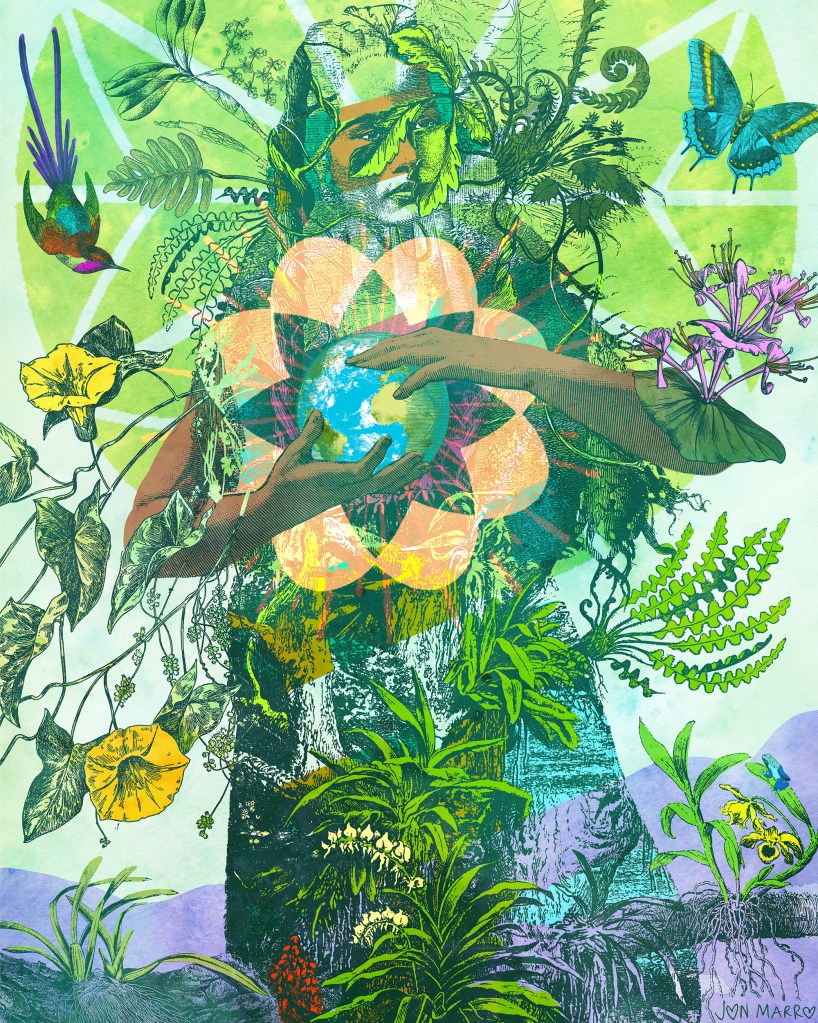
“Pachamama”. Artwork by Jon Marro
Can we aim to heal the separation between humans and nature in our consciousness?
By Vivianna Rodriguez-Carreon, 2025.
We are facing a challenge so profound that planetary flourishing has become a necessary aim.
But can we leap to flourishing without first taking accountability and owning the emotions that caused the crack of separation—between Self and Self, Self and Others, and Self and Nature?
Intellectually, yes; in the realm of Meaning, everything is possible.
Yet it is through embodied Knowing—living through the body as the vessel to consciously connect and free ourselves from the grip of the Known—that we take the essential step toward Wisdom—Conditio sine qua non to see, to know.
Closing the gap between intellectual and embodied Knowing
How do we close the gap between intellectual knowledge and embodied knowledge?
The curation of new, emergent Knowledge begins with healing the fragmentation of both what is known and how the collectively known is embodied.
Curating and healing collective Knowledge are necessary to care for and cure our relationship with the Cosmos, the Planet, and Earth—the Pachamama—that lives within us.
How can Knowledge need healing?
Knowledge has been fragmented, hierarchized in value, and individualized in ownership.
Knowledge and education
Knowledge, the promise of Education, has transcended space and time.
Education rose as a revolutionary force, but it also became entangled in the sourness of its own history.
The ways of producing and distributing Knowledge are connected to many invisible stakeholders, such as Discipline, which itself carries the imprint of historical wounds.
The Knowledge embedded in trainings or curricula designed to be part of education systems also has a colonial history.
For those whose languages were repressed and whose Knowledges were colonized, Knowledge was snatched, oppressed, and forcibly taken.
Knowledge suffers in collective unconscious agreements when frameworks dictate how expression must occur, locking it into linear language and codifying it through norms.
In this process, the way Knowledge is conveyed becomes presented as fact or truth, while the systemic tools of ownership and individualization remain hidden.
Colonialism and Oppression
Colonialism depended on oppression—and therefore, on oppressors.
Oppression is a system of expansion and extraction that categorizes Meaning—another invisible stakeholder—within a hierarchical order.
Oppressors embodied these hierarchies, using abstracted tools to maintain them. One such tool is Discipline, framed across cultures to educate through Schools, Families, and Service systems. When Discipline comes to mean courage, for example, as part of training to be “strong,” the Meaning of strong is absorbed into the Meaning of courage.
For many oppressors, their Discipline becomes the contract of disembodiment: only by oppressing their own nature and disconnecting from their bodies can they remain loyal to the imposed Meaning of Discipline.
Consciousness and Experience
Living a conscious and experiential life embodies a different quality of Knowledge. Consciousness becomes an imprint, making the human body the vessel of experience.
But when Discipline is exercised as a tool to break the body, being disembodied becomes a means of survival. Not being conscious of the implications of, for example, the traumatic ways of receiving Discipline, the mind seeks Meaning. The mind is loyal to Meaning.
The how of Discipline is pushed into the subconscious, while Meaning takes over. The sensations and feelings of receiving Discipline are stored, frozen, and sometimes unconsciously relabeled with an inner sign that reads “courage,” instead of pain.
It is an act of courage to revisit pain, the way Meaning was conveyed into Knowledge, for both Oppressors and the Oppressed. It is in the how that the real Meaning of the label awaits to be seen, so it can continue its evolution into Wisdom.
Healing Collective Knowledge
Curating and healing Knowledge is about reclaiming the Agency to integrate how we know what we know.
Having the courage to reunite our separated parts leads to emergent ways of Knowing. Only then, disentangled from what we thought we knew, can we experience Knowledge as a verb, revealed through embodiment rather than static.
Flourishing is not individual, for it depends on everything to which it is connected.
Healing and curating involve consciously owning the journey of embodying the fragmented parts, caring for and curing the Known, which sets us free to see the world as fresh each time we encounter it.
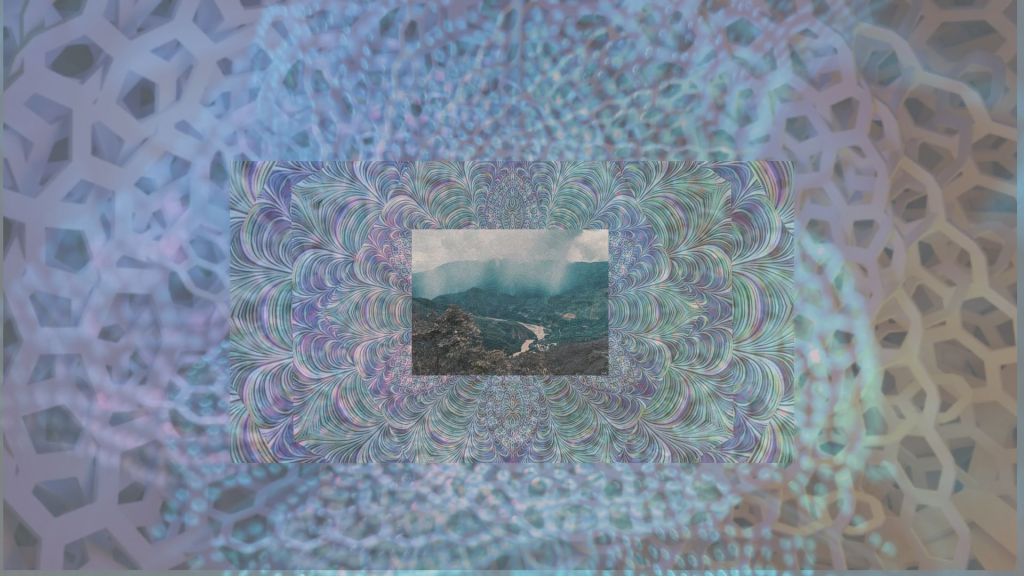
The Inner World
Language
By Vivianna Rodriguez-Carreon, 2024
Poetry as a Step to Integration
When I saw the split of the outer world,
I went to explore life in the inner world.
Inwards,
venturing to find a phenomenon, is an inner force away from fragmentation.
Interconnecting within,
invisibilising the bridge to the outer,
I stand still.
Collapsing to puhpowee,
a force in the Potawatomi language that enables to visualise the outer change,
the flourishing from the interconnected mycelium network.
An in-power-moment,
to value only to be seen from within,
where not written code can capture.
The language of the inner world is everywhere and cannot behold anywhere.
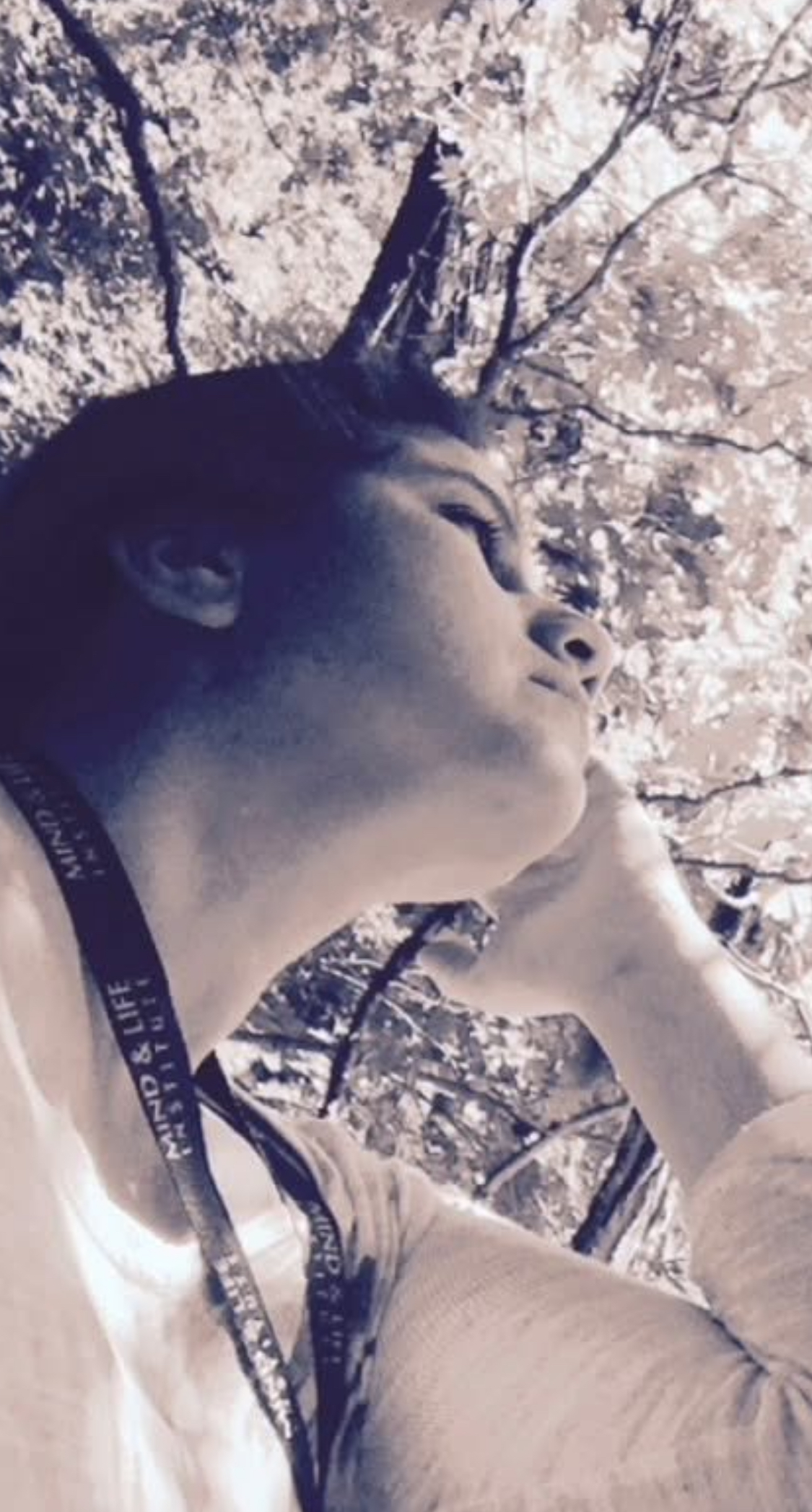
Inside and Ouside are Inseparable
Maurice Merleau-Ponty
We are in dadirri.
Dadirri, a language of the Aboriginal people of the Daly River region.
It is the listening, the contemplating, the reading of nature.
I am holding, far from the split, from the categories and the labels of identity.
Being in the invisible network to see and to be seen.
I sense iñiy, a Quechua word from my native Cusco.
In iñiy I sense the transition state to be able to trust.
It is an expression, a “license” to believe the invisible,
to value in me, the Other and the system.
Perhaps it is the liminate space to meet the outer.
In presencing the doing I meet the split again, this time conscient,
then agency emerges to lead from the whole.
 Vivianna Rodriguez Carreon